

If you’re dealing with ongoing joint or soft tissue pain, you’ve probably tried a few things already — rest, stretching, maybe injections or physical therapy.
So when you hear about shockwave therapy (StemWave), one of the first questions is:
“What actually happens—and will it work for me?”
Let’s walk through exactly what to expect, who it’s best suited for, and how to know if it’s the right next step.

First, What Is Shockwave Therapy?
Shockwave therapy—also known as regenerative shockwave or StemWave—is a non-invasive treatment that uses acoustic wave technology to stimulate healing in damaged tissue.
Instead of masking symptoms, it works by:
- Increasing blood flow
- Breaking down scar tissue
- Activating cellular repair responses
The goal is simple:
👉 Help your body restart a healing process that has stalled.
Who Is a Good Candidate for StemWave?
There are some situations where we pause or modify care, including:
- Pregnancy
- Active cancer
- Recent surgery (within ~6 weeks)
- Active infection in the treatment area
- Certain inflammatory or autoimmune conditions
That said — there are also gray areas.
And that’s why we don’t rely on guesswork.
What Happens at Your First Visit (Diagnostic Mapping Session)
Before any treatment begins, we start with a Diagnostic Mapping Session.
This is where we:
- Assess the exact location and depth of tissue dysfunction
- Identify whether the tissue is likely to respond
- Determine the right treatment approach
This step is critical.
Because not all pain is created equal — and precision matters.
What Does Treatment Feel Like?
Most patients describe shockwave therapy as:
- A tapping or pulsing sensation
- Slightly uncomfortable in sensitive areas
- But very tolerable overall
Sessions are quick — typically 5–10 minutes per area.
And there are:
- No needles
- No downtime
- No anesthesia required
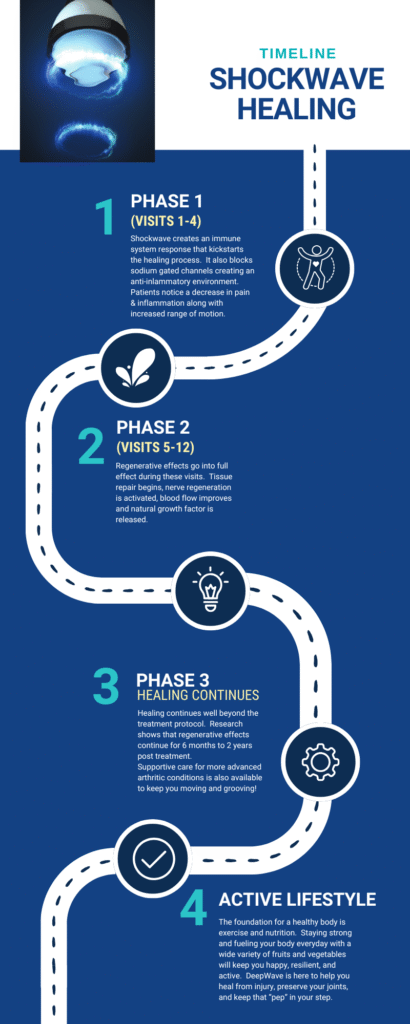
What Does the Treatment Timeline Look Like?
Shockwave therapy works through a structured healing process, not a one-time fix.
Phase 1: Calm + Activate (Visits 1–4)
- Reduces inflammatory signals
- Improves circulation
- Begins pain relief
Phase 2: Regenerate (Visits 5–12)
- Stimulates stem cells and healing factors
- Enhances collagen synthesis
- Activates nerve regeneration
- Triggers tissue repair
Phase 3: Continue Healing (After Care)
- Your body continues repairing for 6 months to 2 years post treatment
- Strength and stability become key
A typical plan:
👉 2x/week for 2 weeks
👉 then 1x/week for 4–6 weeks
When Will I Start Seeing Results?
This is one of the most common questions — and the answer is:
It depends on your condition and how long it’s been there.
That said:
- Some patients feel relief within the first few visits
- Others notice gradual improvement over several weeks
- The most meaningful healing continues after treatment ends
This is not a temporary fix — it’s a process of restoration.
How Long Do Results Last?
Because this therapy stimulates actual healing (not just symptom relief), results can last:
👉 Months to years
In some cases, even longer — especially when supported by:
- Strengthening
- Movement therapy
- Lifestyle changes
For more advanced degeneration, occasional maintenance may be recommended.
What If I Have Pain in More Than One Area?
We can absolutely address multiple areas.
- Each area is evaluated and mapped separately
- Up to two areas can be treated during a session
- Custom plans can be built for multi-site care
This allows us to stay precise while still being efficient.
Is This Better Than Injections or Surgery?
That depends on your situation — but many patients choose shockwave therapy because it is:
- Non-invasive
- Drug-free
- Designed to promote natural healing
- Lower risk than injections or surgery
For the right candidate, it can be a powerful alternative.
How Do I Know If It Will Work for Me?
That’s the most important question.
And the honest answer is:
👉 We don’t guess. We test.
Your Diagnostic Mapping Session is designed to determine:
- If your tissue can respond
- Where to treat
- And whether this is the right fit
Your Next Step: Get Clarity
If you’re tired of managing pain and want a clearer path forward, this is your next step.
👉 Schedule a Diagnostic Mapping Session
👉 Get answers specific to your body
👉 Make a confident, informed decision
Because the goal isn’t just relief.
It’s getting you back to doing what you love—without hesitation.


Be The First To Comment